

Mutual funds industry has been booming from past some years as people are becoming more interested in investing their money in that because of easy accessibility to invest and high return,this sector has attracted thousands of investors towards it and due to much more awareness about mutual funds through commercials,advertisement this industry has been surge greatly.So,as many millennials are also interested in investing in mutual funds i have decided to start a series of blogs to cover almost everything important about it.
Before starting i would like to share some key facts about mutual funds :
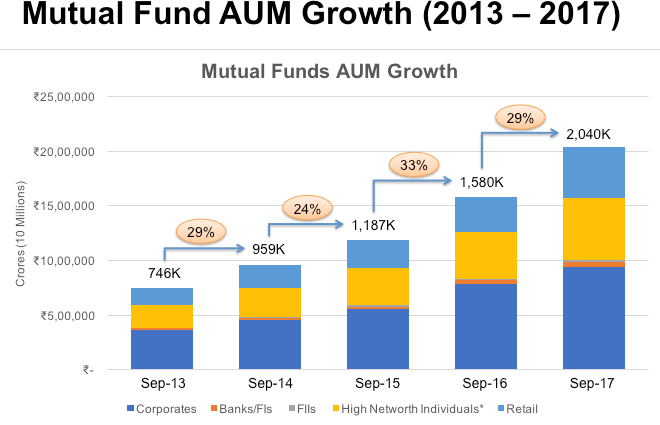
- Assets Under Management(AUM) of Indian Mutual Funds Industry as on Feb 29,2020 stood at 28.94 lakh crore
- AUM of Indian mutual industry grown from 7.6 trillion on feb 28,2010 to Feb 27.23 trillion as on Feb 27,2020 ,which is more than 3.5 times in merely 10 years
- The industry had created the milestone of 10 lakh crore for first time in may 2014.
- Total number of accounts as on Feb 2020 at 8.88 crore
what is mutual funds ?
Mutual funds are a pool of funds from various investors and is professionally managed by some experienced fund managers,who will further invest the accumulated amount into different sectors as per the financial goals of investors and other related factors.
There are different types of mutual funds scheme and as per the financial objective of investors,they should invest in mutual fund schemes. Mutual funds are become easy to invest option for investor as their is no more complexity related as compared to investing in share market,where one needs to proper analyse the stock fundamentally and technically and i agree that you still have to analyse before investing in mutual funds but there is more risk in losing money in share market as compared to mutual funds because of less volatility and also due to the fact that mutual fund are managed by more experienced and more knowledgeable manager, they can invest more properly than retail investors. The primary aim of a mutual fund scheme is to create wealth or earn income by investing in diverse assets.
Types of Funds
Open-Ended funds
Open-ended means one can enter and exit the fund anytime, at daily NAV(it is the value of per unit of mutual funds. For example, you can exit from equity funds, which are essentially long-term products, within 6 months.
For example : ICICI Prudential Banking and Financial Services Fund, Motilal oswal multicap 35 funds
Close-Ended funds
- These funds are majorly used for long-term investments mainly for 3 to 5 years to avoid the volatility caused by huge redemption
- It means one can exit after a certain period on expiry of the term, the portfolio is liquidated and the funds are distributed
- Close end funds also has liquidity option these funds are listed on the exchange where one can sell their units to another at listed price,and list price is mainly lower than NAV
Interval funds
- Investor funds are suitable for those who wants to invest for long term but also wants the liquidity feature
- Interval funds are a type of close end funds that become open to transaction during a preset interval periods,for example first 5 days
- Fees for interval funds tend to be higher than for other types of mutual funds, as do returns
To get the liquidity feature in close-ended funds, there is another category called ‘interval’ funds. Essentially, these are close-ended funds that become open to transactions during preset interval periods, for instance, first 5 days of every quarter.
Active vs passive funds
Active funds are those funds in which the funds manager actively buy and sell securities based on his knowledge,expertise on market,sector and economy.
- Because of the fact that fund manager actively buy and sell security,the expense ratio is also higher than passive managed funds.
- It also sees that sometime fund manager can able to outperform the market and generate higher return.
Passive funds are those funds which imitate the market indices such as S&P BSE sensex or NIFTY 50 means the return on your money invested in mutual funds is based on the market index if the index rises then your return also rise or vice-versa.
- As passively managed funds doesn’t demand research and analysis,the expense ratio is also seemed to be lower than active funds
- You can track the performance of your mutual funds by just analysing the performance of the market index,for example if the market indices rise to 2% than your money did the same thing.
Debt,equity and hybrid funds
Debt funds
A debt funds is a fund that invest in fixed income securities like bonds,commercial papers,debentures etc.
- On average, the fee ratios on debt funds are lower than those attached to equity because the overall management costs are lower.
- Debt funds are characterised by length of time period such as Money market funds or instrument are for shorter term mainly for 6-12 months and long term which has horizon for more than 1 year
- Debt-funds are less riskier than equity funds
Types of debt funds
Liquid/money market funds
The money is invested in money market instrument like treasury bills etc which have a maturity period of 91 days,this funds offers lower return as compared to other long term horizon funds
Income Funds
Income funds invest in a mix of government and corporate fixed income securities such as bonds, debentures and commercial papers with extended maturity period.These funds have a stability than other funds.. The average maturity of income funds is around 5-6 years.
Ultra Short Term/Short Term Funds :
Those investors who wants to invest for 6 months to 1 year can invest in ultra short term or short term funds because of the high maturity period the returns over this funds is also high.
Gilt funds
Gilts funds invest only in high rated government securities like treasury bills and government bonds. These funds are considered to have no credit risk since government securities are considered to be risk free.These funds offers lower risk as compared to others but it is suitable for those investors who wants their money to be safe.
Fixed Maturity Plans (FMPs)
Fixed maturity plan are a part of close end funds.They have a fixed maturity period ranging from 3 months to 5 years,these funds also invests in fixed income securities like corporate bonds and the government securities one should invest in this funds to keep their money safe but don’t expect a higher return.
Equity funds
An equity mutual funds is primarily invested in stocks.It can be actively or passively (index fund) managed.Equity mutual funds are more riskier than debt funds because of higher volatility in equity funds but equity funds have the potential to give you far better return than debt funds.
Types of Equity funds :
Large-cap equity funds :
- These funds includes stocks of top 100 major companies as per market capitalisation(current price of stock 8 X no of shares issued) across all sectors,these funds are also called (BIG-CAP) and the market capitalisation of large cap funds is above 10,000 crore rupees
- Because of their market capitalisation is so large,investor have to tend to believe on safety of invested money and further growth of company
- These funds are typically used as core long-term investments in an investment portfolio because of their stability and dividends
Mid-Cap Equity Funds
- These funds includes stocks of emerging companies whose market capitalisation is lower than large cap funds but have a potential to grow and give higher return.The market capitalisation of mid-cap funds is between 2,000 to 10,000 crore rupees
- Mid-cap stocks are useful in portfolio diversification as they provide a balance of growth and stability but they are more riskier than large cap funds
Small/Micro Cap Equity Funds
- These funds invested in small companies having market capitalisation of below 2,000 crore rupees
- These funds have potential to give higher return than the large and mid-cap companies but one need to choose it wisely because these funds are more riskier than large and mid cap companies you can even lose own money in these funds
- These firms have experience higher volatility, even some of the small cap company can go bankrupt also.These funds are suitable for those who can bear more risk in return of higher potential.
Equity Linked Savings Schemes (ELSS)
These are the widely known funds for tax saving,many people invests in this fund to save the tax paid by him These funds offer tax benefits upto Rs 1.50 lakh under Section 80 C of Income Tax Act.
Hybrid Funds
- Hybrid funds are the combination of equity and debt funds and due to that these funds have potential to offers higher returns than a regular debt fund while not being as risky as equity funds.
- One should invest in hybrid funds to achieve diversification and avoid the concentration risk.
Types of Hybrid funds
Monthly Income Plan (MIPs)
MIPs invest a large potion in AUM in debt securities for safety of investment and small portion in equity funds for higher returns.
Balanced Funds
Balanced funds are those funds which invest a significant portion in either debt securities or equity market. If a balanced fund has allocated more than 65% of its AUM to equity and equity related instruments, and rest in fixed income securities, it is called ‘Equity-oriented Balanced Fund’.
On the other hand if its investment in equities is less than 65% then it is called ‘Debt-oriented Balanced Fund’.
Well,mutual funds is better option for investment for people who doesn’t have good knowledge about stock market and also for investor who doesn’t want to take more risk as stock investing because investing in stock is very riskier as well as demand more capital.So,mutual funds are best suitable for millennial who just starts earning and wants to invest money anyone can start investing in mutual funds with as low as 500 rupees and it will creates value for you in future. So this is the first blog in the series about mutual funds we will back to you with further more.
References :
 The Millennial Investor